Signs your pool filter needs cleaning, and what a filter clean involves
The filter works constantly and quietly, and when it's loaded up, your pool tells you in a handful of ways.
October 20, 2026 · 4 min read
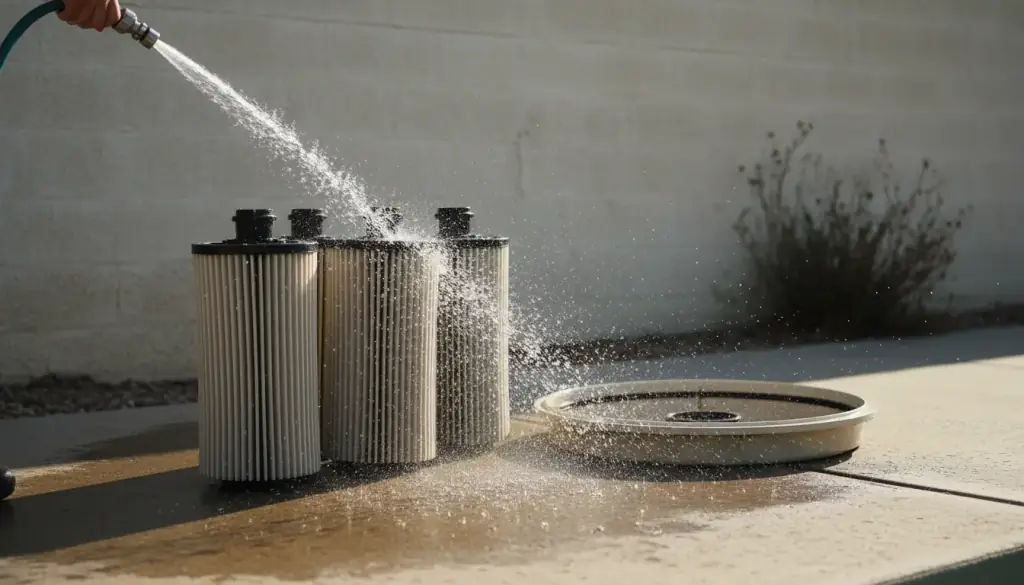
Your pool filter is the part of the system doing the most unglamorous job. Every gallon of water that goes through the pump passes through the filter, and the filter pulls out everything the skimmer missed: fine dust, pollen, dead algae, sunscreen, hair, and the leftover pieces of leaves. It does that all summer without complaint. Then one day it's full, and the pool starts behaving oddly. Here's how to recognize it, and what a proper clean looks like.
Signs it's time
The most common sign is water that won't stay clear. If the chemistry tests fine but the water has a dull, hazy look that comes back no matter what you add, the filter is often the reason. It can't catch fine particles anymore, so they keep cycling through the pool.
The second sign is weak flow. Return jets that used to push a firm stream are now gentle, or the surface skimming slows down and debris sits there instead of getting pulled in. The pump is working against a clogged filter and the water just isn't moving as freely.
The third sign is on the equipment pad. Most filters have a pressure gauge. Learn what it reads right after a fresh clean and write it down. When the needle climbs well above that clean reading, the filter is loading up. You don't need to know a magic number, only how far it has moved from your own baseline.
Algae that keeps returning is another one, because a filter that's saturated can't clear the dead cells after treatment. Chemical demand can also rise: you find yourself adding chlorine more often to keep up. And sometimes the pump itself gets louder or runs hotter, because it's straining against restricted flow.
A filter ignored for too long is not just a cleanliness problem. It forces the pump to work harder, which shortens its life, and in a valley summer, when the pump runs many hours a day, that adds up.
Why filters load up faster here
Dry, dusty summer air means plenty of fine particles ending up in backyard pools. Add trees that drop blossoms or leaves, windy afternoons, and the heavy pool use of summer, and a filter can fill much faster than the same filter would in a quieter climate. Pools that just went through a green-water recovery are the extreme case: a filter can load up with dead algae in a matter of days.
What a filter clean involves
The details depend on the type of filter. With a cartridge filter, the pump is shut off, pressure is released, and the cartridges are lifted out of the tank. They're hosed down pleat by pleat, working along every fold, because the dirt hides deep in the pleats. If the cartridge is oily from sunscreen or body oils, or has a mineral film, it may need a soak in a cleaning solution made for the purpose before a final rinse.
A sand filter or a diatomaceous earth filter is handled differently. These are typically backwashed, which means reversing the flow to flush the trapped debris out to waste, and then rinsed. Sand can eventually clump and channel, and a DE filter needs its media renewed after a backwash.
Along with the cleaning, the technician inspects the filter itself: cracked end caps, a worn o-ring, a torn or flattened cartridge, a leaky valve. A filter that's cleaned but damaged will go right back to cloudy water, so this inspection is part of the job, not an extra.
The chemical check that goes with it
A clean filter is only part of the picture, so the water gets tested at the same visit. Chlorine, pH and alkalinity are checked and corrected, since a freshly cleaned filter often exposes chemistry problems that the clogged one was masking. Filter and chemistry work best as a pair.
How often it should be done
There isn't one right answer. A shaded pool under a mature tree needs it more often than one in an open yard. A heavily used family pool loads up faster than one swum in occasionally. A good rule is to let the gauge and the water guide you, and to schedule a clean at the start of summer and again after any algae event. Pool owners on a weekly service get the benefit of someone watching that gauge every visit.
When cleaning isn't enough
Filter parts wear out. A cartridge that's cleaned and still shows a quick pressure rise, with flattened or frayed pleats, is finished and needs replacing. If a filter won't hold its clean reading even after a good wash, the media or the internal parts are likely worn, and that moves from maintenance into repair.
Crystal Blue Pool Service and Spa cleans filters and runs the chemical check in the same visit across Visalia, Tulare, Hanford, Lemoore and Porterville. Filter cleans are at $125.00. Read more at /pool-filter-cleaning-and-chemical-check or call (559) 679-5599.
Crystal Blue Pool Service and Spa, (559) 679-5599
Call (559) 679-5599More articles
What a weekly pool service visit actually covers
Most of a good weekly visit is catching small things while they're still small, and the schedule matters more than people expect once the heat arrives.
How a green pool gets brought back, and how to keep it from happening again
Green water looks like a disaster, but it follows a predictable recovery, and most of the work is in the order the steps happen.