Repair
Find the fault first, then repair the pool.
Leaking pipes and valves, cracked tile, rough plaster, pumps and heaters that quit, breakers that trip. Every repair starts by proving what is actually wrong.
Chapter 01
What gives out on a valley pool
Long dry summers are hard on a pool. Plaster and tile swell in afternoon heat and settle back overnight, hard fill water leaves calcium along the waterline, and equipment that runs ten hours a day will eventually quit. Most repair calls trace back to a short list: damage to the liner, shell or tile, a leaking pipe or valve, a pump, filter or heater that stopped doing its job, or an electrical fault such as bad wiring or a breaker that keeps tripping.
Crystal Blue repairs all of those on residential and commercial pools across Visalia, Tulare, Hanford, Lemoore and Porterville. The symptom you notice, a pool that drops an inch a week or a pump that will not start, is rarely the whole story, which is why a visit begins with locating the real fault.
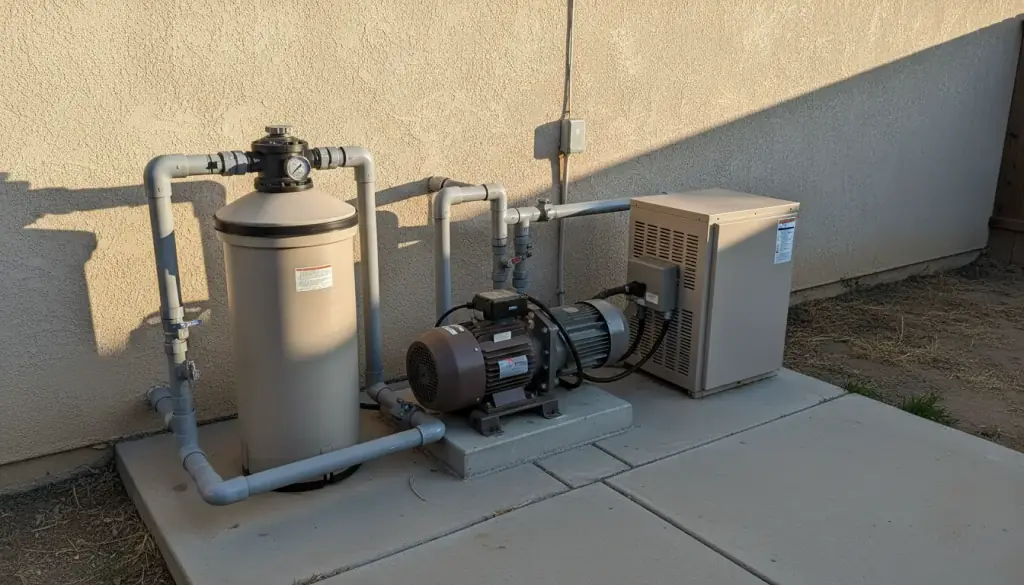
Pool equipment pad against a stucco wall with a cartridge filter, pump and heater
How a repair visit runs, in order
The fault comes before the part. Pressure at the filter says whether water is moving, flow at the returns says whether the pump is keeping up, and power at the equipment says whether a motor or heater is being fed at all. Swapping a part before those three readings are in is how a second visit gets booked.
Once the cause is known, the part is repaired or replaced, whichever the fault calls for. A cracked valve body gets replaced. A breaker that trips may point to a motor drawing too much current rather than a bad breaker. Then the system is started, run through a full cycle, and the same readings are taken again, so the fix is confirmed on the equipment pad and not assumed.
Chapter 03
Pool Leak Repair, plaster and tile
Water that leaves where it should not is the most common reason people call. Leaky pipes and valves show up as a pool that loses more than evaporation explains, wet ground near the equipment pad, or a pump that keeps losing its prime. Those are tracked to the joint, valve or run of pipe and fixed there.
Surface damage gets the same attention. Plaster repair patches the shell where it has chipped or gone rough, and tile replacement swaps out cracked or lifted tile along the waterline, which also keeps debris and calcium from catching in the gaps.
After any repair, watch three things: the pressure gauge on the filter, how much water the pool loses in a week, and whether a breaker trips again. If one of them drifts, call the office at (559) 679-5599 (Mon to Fri, 6 AM to 6 PM) and say what changed.
"Great service and great communication!! Highly recommend 100%!! 10/10!!" Chloe Sena, Google review